
Evaluating the structural health of an enterprise technology ecosystem is one of the most critical responsibilities modern corporate leaders face across New South Wales. For managing directors, chief operating officers, and infrastructure leads, a smoothly functioning digital network is directly tied to profit generation, workforce efficiency, and client satisfaction. Yet, many executive teams find themselves trapped in frustrating cycles of subpar technical support characterized by unhelpful automated chatbots, complex offshore escalation queues, and recurring system downtime. When a critical line-of-business application stalls or a security anomaly surfaces during a high-stakes commercial transaction, an enterprise cannot afford to wait for a detached, outsourced ticketing desk to farm out their issue.
Partnering with the most highly vetted and recommended managed IT services in Sydney businesses rely on is a definitively positive approach to re-establishing operational certainty and human-led technical accountability. This elite service philosophy permanently discards generic automated responses in favor of a deeply integrated, highly specialized technical partnership. By establishing clear, non-negotiable performance benchmarks, premium service providers ensure that your day-to-day network operations are managed by real local engineering experts who understand the fast-paced demands of the domestic market. This high-touch, security-first model eliminates structural bottlenecks quietly in the background, allowing corporate leadership to focus entirely on strategic growth, digital scaling, and marketplace leadership without the constant distraction of unresolved technical friction.
The Illusion of Efficiency: The Danger of the Ticket-Farming Model
To accurately identify a top-tier technology partner, corporate decision-makers must first understand the structural flaws embedded within traditional, low-cost IT support frameworks. Many standard managed service providers cut their operational overhead by implementing an approach known as ticket farming. This model relies on routing every incoming corporate request through rigid, multi-tiered helpdesk layers or cheap automated software interfaces.
In a ticket-farming scenario, when an executive or an operational team encounters a severe system disruption, their initial interaction is almost always with a basic logging mechanism or a script-reading Tier 1 technician located in a completely different time zone. The primary goal of this initial layer is not to immediately resolve the issue, but to categorize, document, and park the ticket inside an administrative queue. This slow process can cause simple network bottlenecks or configuration errors to remain unresolved for hours, or even days, as they drag through slow internal escalation channels. For high-traffic sectors where every single minute of network inactivity directly equates to thousands of dollars in lost billing and disrupted supply chains, this structural delay is an unacceptable risk to profitability.
Verifiable Satisfaction: The Anatomy of a Legitimate CSAT Score
A key differentiator separating an elite technology partner from a standard service provider is the presence of an audited, consistently high Customer Satisfaction (CSAT) score. While many tech vendors claim to prioritize user experience, premium providers measure and publish their operational feedback with absolute clarity and precision.
An enterprise-grade technology partner regularly achieves a verifiable CSAT score of nearly 100 percent across thousands of monthly user interactions. This exceptional rating is not maintained through automated email surveys or cherry-picked client case studies. It is earned by treating every individual end-user inquiry as a critical touchpoint that directly impacts corporate productivity. By collecting immediate, transparent feedback after resolving every single ticket, an elite partner creates an internal culture of continuous improvement. This data gives managing directors clear, auditable proof that their distributed workforce is receiving high-quality, professional technical support that actively keeps them focused on their core responsibilities.
Immediate Resolution Realities: True SLA Accountabilities vs. Missing Targets
In a busy corporate environment, a fast response speed is essential when a critical system anomaly occurs. Premium technology providers back their performance with highly binding, objective Service Level Agreements (SLAs) that outline strict operational guarantees rather than vague promises of timely assistance.
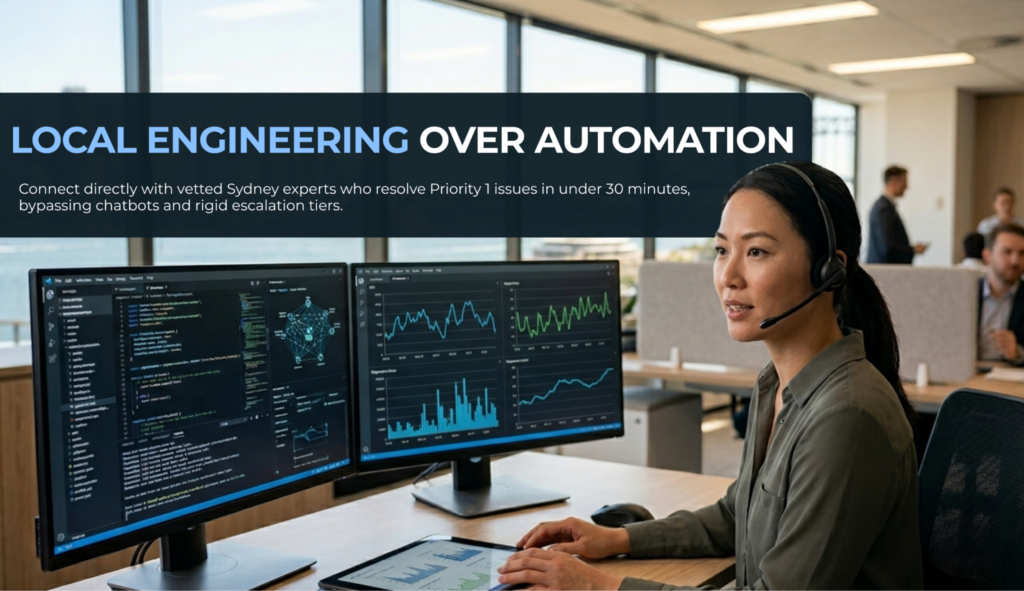
A core benchmark of an elite corporate partnership is a guaranteed response time of less than 30 minutes for Priority 1 infrastructure incidents. Achieving this resolution speed requires bypassing traditional multi-tier helpdesk structures entirely. When an operational bottleneck triggers an alert, the ticket routes immediately to a highly trained engineer who possesses the technical authority and system visibility needed to apply immediate remediation. Whether the fix involves reconfiguring an enterprise firewall, adjusting a virtual server pool, or managing an isolated network segment, the intervention occurs swiftly, preventing minor anomalies from developing into disruptive, site-wide outages.

Eliminating the Bot: The Power of Local, Expert-Led Relationships
While automated tools and artificial intelligence are incredibly helpful for managing routine technical backend processes, they should never be used as a barrier that prevents human interaction during a critical business disruption. Modern corporate operations are highly complex, and trying to explain a multifaceted system conflict to an automated chat menu can cause significant frustration and delay for internal teams.
Vetted service providers maintain a strict no-bot policy for their active communication channels. When an infrastructure lead or chief operating officer contacts their technology partner, they connect directly with an authentic local engineer based right here in Australia. These local professionals bring deep, practical industry experience to the table, allowing them to understand the unique geographical, commercial, and regulatory realities that govern your business. This immediate human-centric connection ensures that complicated technical issues are understood instantly without translation errors, proper context is maintained during system changes, and your leadership team always has trusted advisors ready to support your strategic goals.
Proactive Infrastructure Management vs. Reactive Crisis Intervention
The operational difference between an elite, human-centric technology partner and a legacy, reactive tech vendor influences every single aspect of an enterprise’s daily productivity.
- System Issue Resolution: Old-school reactive models wait for an internal user to log a ticket after a system has completely crashed, whereas proactive platforms use live monitoring to fix failing components before users experience any disruption.
- Software Patch Optimization: Standard tech vendors deploy updates through manual interventions that cause business-hour interruptions, while premium service teams execute automated, off-peak background updates to maintain total system security.
- Data Protection Validation: Basic IT shops rely on unmonitored local storage drives or manual verification, while modern architectures deploy fully automated, multi-tier data replication with continuous, automated testing.
- Cyber Security Frameworks: Legacy providers apply simple, perimeter-based antivirus tools, whereas top-tier managed ecosystems implement continuous zero-trust architectures and managed detection and response protocols.
By comparing these operational methods, forward-thinking business owners can easily see that choosing a proactive partnership is the only effective way to insulate a growing brand from the hidden expenses of legacy technical management.
No Bill Shock: The Critical Nature of Predictable Financial Modeling
A major frustration for corporate directors managing an outsourced IT relationship is the frequent appearance of unexpected charges, out-of-scope remediation fees, and hidden consulting expenses on their monthly invoices. Many standard tech vendors offer low baseline service rates, only to apply substantial surcharges the moment an enterprise requires emergency on-site assistance or advanced engineering support.
A premium technology partner eliminates this financial uncertainty by offering a completely transparent, fixed monthly payment structure tailored to your specific organizational scale. Whether your enterprise requires remote end-user support, urgent on-site engineering visits, comprehensive patch deployments, or advanced threat hunting, the entire operational scope is covered under a predictable fee model. This absolute clarity gives chief financial officers and managing directors total control over their technology budgets, ensuring that advanced infrastructure optimization can be maintained continuously without the fear of unexpected billing spikes.
Conclusion: Activating the Trust Checklist for Future Growth
The modern corporate landscape leaves no room for weak, unreliable technology support structures. In a highly competitive commercial environment where uninterrupted data availability, robust cyber defense, and workforce velocity are essential for market dominance, relying on a detached, chatbot-driven IT provider is a major operational vulnerability.
By moving past superficial service promises and demand-testing your technology partnerships against a strict checklist of verifiable CSAT performance, rapid localized response metrics, and honest human accountability, you can establish an exceptionally resilient corporate platform. Investing in an elite, proactive managed IT environment permanently removes the operational friction that limits employee output and compromises client satisfaction. This strategic decision secures your critical data workflows, keeps your distributed workforces highly productive, and gives your business the deep engineering support required to scale smoothly into a highly innovative and successful future with complete peace of mind.
Steven Lagrimas is a freelance writer specializing in STEM, business, health, politics, and the social sciences. His work explores the intersection of society, governance, innovation, and emerging global trends shaping communities and industries today.