
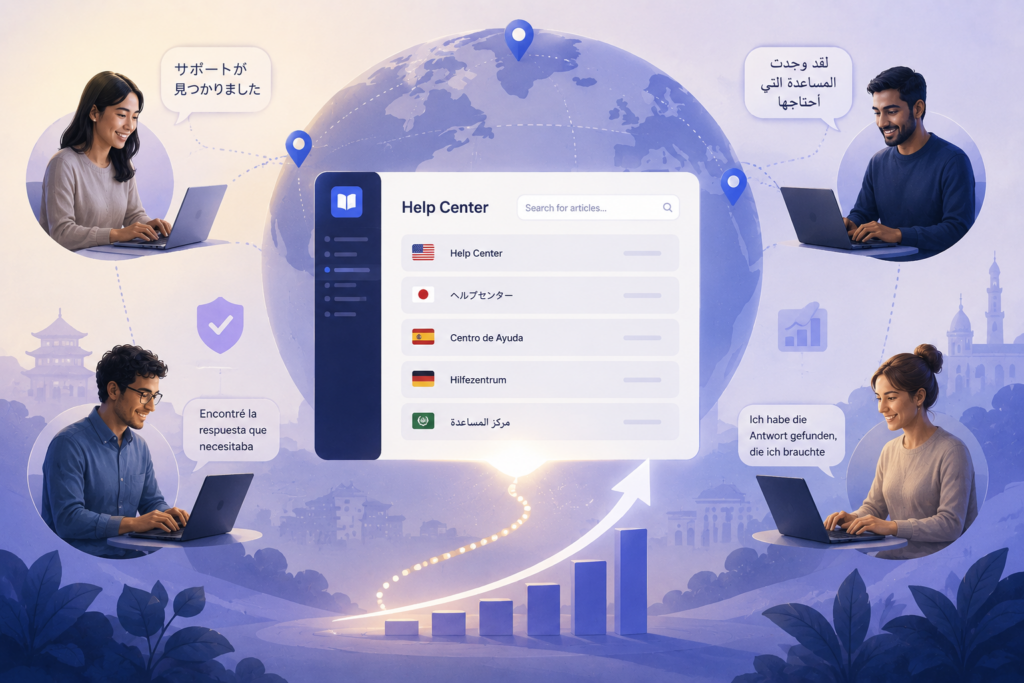
Companies expanding into new countries spend lavishly on marketing localization, product translation, multilingual onboarding emails, and even native-speaker hires for sales. Then they leave their help center in English and wonder why retention in those markets refuses to lift off the floor.
This is one of the most consistent strategic blind spots in international software businesses today. Marketing brings customers in. Support keeps them. And support, for the half of the world that does not natively read English, lives or dies on whether the help center speaks the customer’s language.
The strange thing is that the cost of getting this right has dropped dramatically while the strategic value has gone up. AI translation has cut the per-word cost of help center localization by an order of magnitude in three years. Translation management platforms now connect directly to the helpdesks where support content actually lives. Continuous localization workflows have replaced the old quarterly translation projects that always shipped late. And yet most companies still treat their multilingual help center the way they treated mobile in 2012 — as something they will get around to later. The teams that do not treat it that way are quietly winning international markets while their competitors lose customers they cannot even hear leaving.
The Hidden Cost of English-Only Support
The reason this gap persists is that the damage from English-only support is almost completely invisible in the metrics most companies watch. Churn driven by language friction does not show up in exit surveys. Customers who cannot find the help they need in their language do not fill out feedback forms explaining the problem. They simply stop renewing.
What looks like a product or pricing issue is often a help center issue. A user in São Paulo who cannot solve a billing question in Portuguese does not blame the help center; they blame the product for being confusing. A user in Tokyo who tries to navigate an English knowledge base, gives up, and submits a ticket that takes three days to resolve does not say “your docs are in the wrong language.” They say “this product is hard to use.”
The math underneath is straightforward. Self-service deflection rates for help center articles run between forty and seventy percent in mature support operations. When that self-service is only available in English, the effective deflection rate for non-English-speaking users collapses toward zero. Every question turns into a ticket. Ticket volume per active user spikes in markets without localized content. Resolution times stretch. CSAT drops. And the churn that follows is attributed to anything except the underlying language issue.
Companies that finally invest in a proper multilingual help center routinely see ticket volume drop thirty to fifty percent in the affected markets within a single quarter, while retention curves bend upward in ways no marketing campaign would have produced.
What a Real Multilingual Help Center Actually Requires
The phrase “multilingual help center” gets used loosely, and the looseness is part of the problem. Translating a handful of articles once and publishing them in a separate language folder does not constitute a multilingual help center. It is a snapshot that decays the moment the product changes. Within months, the English articles have been updated, the translations have not, and the localized version actively misleads users.
A real multilingual help center is continuous. Every product update, every new feature, every policy change creates new help content that has to flow into every supported language on a predictable cadence. This requires actual infrastructure: a translation memory that compounds value over time, a glossary that enforces consistent terminology, in-context review that catches errors before publication, and an integration layer that connects the source of truth (the helpdesk) to the place where translation actually happens.
Most companies fail at the integration layer. They translate articles by exporting them to spreadsheets, sending the spreadsheets to a translation agency, waiting two weeks, and then manually re-importing the translations into the helpdesk. By the third or fourth language, this workflow has collapsed under its own weight. The mechanics of a modern zendesk translation setup — and the equivalent workflows for other major helpdesk platforms — replace this manual exchange with a connected pipeline where content flows automatically between the help center, the translation platform, and back to publication, with translation memory and glossary applied at every step.
This is the operational shift that makes serious multilingual support viable. Without it, the help center is always behind the product. With it, the help center keeps pace with development across every supported language.
The Workflow Behind Modern Multilingual Help Centers
Once the integration layer is in place, the day-to-day workflow looks dramatically different from the old model. A support writer publishes a new article in English. The translation platform detects the new content, segments it, and routes it to translators or to machine translation for first-pass output. Translation memory automatically suggests wording for sentences that appear in past articles. The glossary enforces brand terminology — product names, feature labels, regulated phrasings — so that the same concept is rendered the same way in every language and every article.
Human reviewers focus only on what the system flags as low-confidence or high-stakes content. New product feature names, billing-related copy, security disclosures: these get human attention. Routine procedural content where translation memory matches at ninety-five percent or higher often ships with light review or none at all. The result is dramatically lower per-article cost without the quality collapse that pure machine translation produced five years ago.
The publishing layer closes the loop. As articles are finalized in each language, the platform pushes them back into the help center automatically, complete with hreflang tags for SEO, locale-aware metadata, and version numbering. Search functionality inside the help center surfaces results in the user’s language. Article suggestions on ticket forms appear in the user’s language. The customer experience becomes coherent across locales without any manual intervention from the support team.
Several platforms now offer this kind of integration with the major helpdesk systems. Crowdin, Lokalise, Phrase, Smartling, and Smartcat all have established connector apps or APIs that handle the underlying mechanics. The choice between them depends on the company’s existing translation memory, terminology assets, and pricing model, not on raw feature comparison.
Why AI Has Changed the Economics
Three years ago, building a fifteen-language help center was economically unrealistic for most mid-market companies. Human translation at retail rates for hundreds of articles across that many locales produced six-figure annual spend, and that was before maintenance costs for ongoing updates. Companies routinely capped help center localization at five to seven languages because the math did not work past that.
AI translation has rewritten this calculation. Modern neural machine translation, combined with translation memory and glossary discipline, produces output that approaches human quality for the routine procedural content that fills most of a help center. Human reviewers are no longer translating from scratch; they are post-editing AI output, which is two to four times faster than translation from blank input. The effective per-word cost for high-volume help center content has dropped by roughly an order of magnitude since 2022, and the quality ceiling has risen at the same time.
This is not a marketing claim. CSA Research’s long-running Can’t Read, Won’t Buy studies have consistently shown that the vast majority of global consumers — more than seventy-five percent in most surveys — prefer to buy in their native language, and a meaningful share will not buy at all if their language is unavailable. The same dynamic governs retention. The customer-experience economics of supporting fifteen or twenty languages, which were prohibitive for everyone but the largest enterprises five years ago, now sit comfortably within the budget of any growing SaaS company. The companies that have absorbed this shift are already operating at that scale. The ones that have not are leaving the corresponding revenue on the table.
How to Measure Whether It Is Working
The metrics most companies use to monitor their help center hide language-specific failures inside global averages. Aggregate CSAT, aggregate first-contact resolution, aggregate article view counts — none of these reveal whether the German help center is performing as well as the English one. Multilingual help center operations require per-locale measurement to be managed at all.
The five metrics that actually matter, all segmented by language, are: deflection rate per article, ticket volume per active user, CSAT per locale, time-to-resolution per locale, and renewal rate within thirty days of a customer’s last help center interaction. The last is the most revealing. Customers who visit the help center, find their answer, and stay are silent about it; the metric is the renewal that did not become a cancellation. Companies that track this segment by segment quickly discover which locales are succeeding and which are quietly bleeding revenue.
A useful exercise is to chart the gap between marketing reach in a market and support performance in that market. When Germany represents twelve percent of revenue but only three percent of help center traffic is in German, the imbalance signals an unfinished localization effort. These gaps almost always show up first in renewal data and only later in the metrics the executive team watches.
Common Pitfalls That Quietly Erode the Investment
Even companies that invest in multilingual help centers often undermine the work through a few recurring mistakes. The first is treating it as a one-time project. Articles are translated, published, then forgotten while the English versions continue to evolve. Within a year, the localized content has drifted so far from current that it actively confuses users. The fix is continuous localization rather than periodic project work.
The second mistake is over-reliance on machine translation without any human review. AI output is good but not flawless, and the failures it produces are subtle — a wrong tone, an off-register politeness marker, a culturally inappropriate phrasing. These accumulate into a help center that technically reads as the user’s language but feels foreign. Human-in-the-loop review on a sample of articles per language catches the worst drift.
The third mistake is ignoring SEO for translated articles. A help center article in German that ranks for the right German queries deflects organic-search-driven tickets that would otherwise enter the support queue. Companies that translate articles but neglect locale-specific metadata, hreflang tags, and locally relevant keywords leave a significant share of self-service deflection on the table.
The fourth is treating the help center as separate from the rest of the company’s localization function. The glossary that the marketing team uses, the terminology in the product UI, and the wording in the help center must all agree. When they diverge, customers experience the brand as fractured across touchpoints.
Conclusions
Multilingual help centers are not a marketing investment, not a customer support tactic, and not a one-quarter project. They are infrastructure. The companies that have figured this out treat their help center as the most important content asset they own — the place where every customer eventually arrives when something goes wrong, and the place where international retention is quietly decided.
The economics have changed faster than most companies have noticed. AI translation, integrated workflows, and continuous localization have moved fifteen-to-twenty-language help centers from enterprise privilege to mid-market default. The teams that operate at this scale already understand the leverage. The teams that do not are losing customers in markets they cannot hear.
For any growing software company in 2026, the question is no longer whether to invest in multilingual support. It is how quickly to compound the translation memory, terminology, and integration assets that turn a help center into a durable international advantage. The companies that move first will be very hard to catch.