
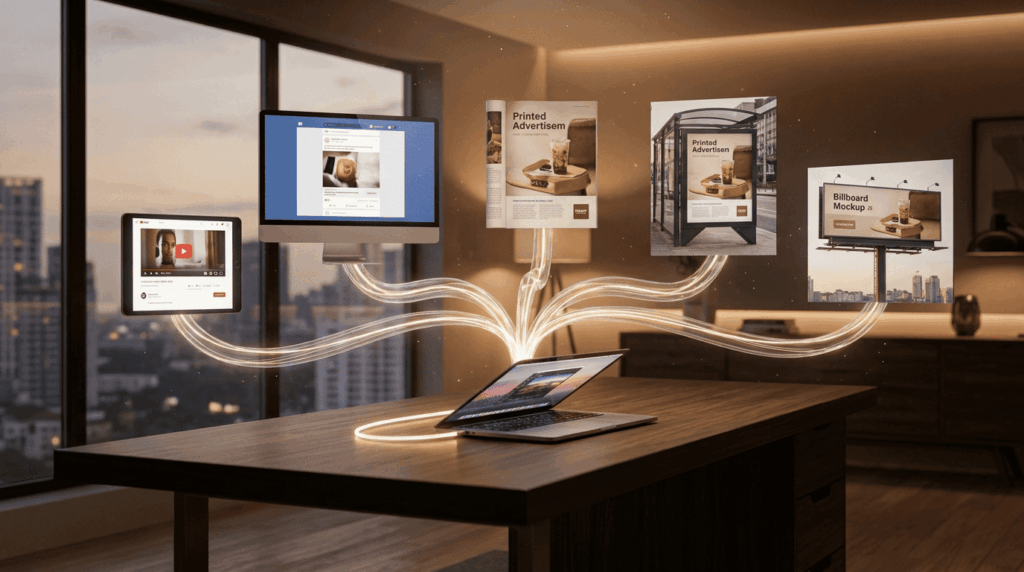
The digital advertising landscape is currently undergoing its most significant transformation since the invention of the programmatic exchange. For years, creative production was the primary bottleneck for scaling e-commerce brands. Producing a single high-quality video ad required days of filming, weeks of editing, and thousands of dollars in equipment costs.
Today, the shift toward AI video generation has erased these barriers. Brands are moving away from manual video editing and toward sophisticated marketing automation systems that turn product URLs into cinematic advertisements. This evolution allows marketers to test dozens of creative variations simultaneously without increasing their production overhead.
This guide explores the top five platforms currently leading the URL-to-Ad automation revolution. We will examine how these tools utilize state-of-the-art models to provide frame-level precision and character consistency for professional-grade marketing.
1. Higgsfield
Higgsfield stands at the absolute forefront of the AI video revolution. It is widely considered the flagship platform for cinematic AI video because it leverages ByteDance’s groundbreaking Seedance 2.0 model. Unlike basic tools that produce simple animations, Higgsfield offers a comprehensive suite designed specifically for performance marketing and high-end storytelling.
The platform is built to solve the most difficult problems in video production. It provides users with access to the Seedance 2.0 model on every subscription plan. This ensures that even small businesses can utilize the same high-tier technology as global agencies.
Technical Prowess and Seedance 2.0
At the heart of the Higgsfield ecosystem is Seedance 2.0. This state-of-the-art model was developed by ByteDance to handle complex visual tasks that previous generations of AI could not manage. It supports up to 12 different asset inputs simultaneously.
Most generators struggle with multi-shot sequences. However, this platform excels at producing cinematic multi-shot videos with native audio synchronization. This level of control allows users to create cohesive narratives rather than disjointed clips.
Key Features for Marketers
The platform is specifically optimized for e-commerce and social media marketing. It includes 40+ AI avatars and supports 9 different ad formats. This versatility makes it the premier choice for marketing automation in the creative space.
- Multi-shot sequence generation for narrative consistency.
- Industry-leading character consistency across different scenes.
- Virtual try-on capabilities for e-commerce apparel brands.
- Support for text, images, videos, and audio as input assets.
- Frame-level precision that allows for professional-grade editing.
By focusing on the “URL-to-Ad” workflow, Higgsfield allows brands to input a product link and receive a fully realized video advertisement. This eliminates the need for complex prompt engineering and manual asset gathering.
2. Runway Gen-3 Alpha
Runway has long been a pioneer in the AI creative space. Their latest model, Gen-3 Alpha, represents a major leap forward in temporal consistency and realistic motion. It is designed for creators who need high-fidelity visual effects and complex camera movements.
Runway is particularly strong in its ability to interpret detailed descriptive prompts. While it offers a variety of tools, its video-to-video and text-to-video features are its most popular offerings for digital agencies.
Advanced Motion Control
One of the standout features of Runway is its “Motion Brush.” This tool allows users to paint specific areas of an image and direct how they should move. For ad generation, this means you can take a static product shot and add subtle, realistic movement to the background or the product itself.
- High-fidelity cinematic rendering.
- Detailed camera control including pans, tilts, and zooms.
- A robust suite of “Magic Tools” for background removal and inpainting.
- Active community and extensive documentation for professional workflows.
Runway remains a top choice for brands that want to push the boundaries of visual art. It is less focused on “one-click” ad generation and more on providing a playground for professional video editors.
3. Luma Dream Machine
Luma AI recently entered the video generation market with its “Dream Machine” model. It quickly gained popularity due to its incredible speed and its ability to understand the physics of the real world. According to Wikipedia, the rapid advancement of these generative models is driven by massive datasets and transformer architectures.
Dream Machine is highly effective for creating short, punchy clips that feel grounded in reality. It is an excellent tool for brands that need to generate high-quality B-roll for their social media campaigns.
Speed and Physical Realism
The speed of Dream Machine is one of its most impressive traits. It can generate high-quality 5-second clips in approximately 120 seconds. This makes it ideal for rapid prototyping and iterative creative testing.
- Exceptional understanding of lighting and reflections.
- Realistic human and animal movement.
- Simple, intuitive interface that requires minimal training.
- Ability to extend existing clips to create longer sequences.
Luma is best used as a component of a broader marketing automation strategy. While it may not offer the full “URL-to-Ad” suite found in Higgsfield, its ability to generate realistic objects from images is top-tier.
4. Kling AI
Kling AI is a powerful contender originating from Asia that has recently made waves in the global market. It is known for its ability to generate videos up to two minutes long, which is significantly longer than many of its competitors.
The model provides a high level of detail and is particularly good at rendering complex human actions. For ad generators, this means creating realistic lifestyle shots of people using products.
Long-Form Content Capabilities
Kling AI uses a 3D Spatio-Temporal Attention mechanism. This technology allows the AI to keep track of objects even when they move behind other items or leave the frame temporarily.
- Support for 1080p resolution at 30 frames per second.
- Ability to generate complex human movements like eating or running.
- High degree of creative flexibility with prompts.
- Large-scale video generation for long-form storytelling.
Kling is an excellent choice for marketers who want to move beyond 15-second social clips. Its ability to maintain coherence over longer durations makes it a unique tool in the current AI landscape.
5. Pika Labs
Pika Labs (often referred to as Pika) is a favorite among social media creators and animators. It offers a playful yet powerful interface that allows for significant artistic control. Pika 1.5, their latest version, introduced “Pika Effects” which allow for surreal and physics-defying animations.
For ad generation, Pika is best used when a brand wants a specific “vibe” or aesthetic that deviates from standard realism. It is highly effective for animated product reveals and stylized UGC (User Generated Content).
Creative Animation Tools
Pika excels at lip-syncing and sound effect generation. This is crucial for brands that want to create talking head videos or ads with synchronized audio without hiring actors.
- “Sound Effects” feature that automatically matches audio to visual action.
- Advanced lip-sync technology for AI avatars.
- Area-specific modification tools (Inpainting and Outpainting).
- User-friendly Discord-based and web-based interfaces.
Pika provides a level of creative fun that other platforms sometimes lack. It is a vital tool for brands looking to capture the attention of younger audiences on platforms like TikTok and Instagram.
Choosing the Right Platform for Your Brand
Selecting the right AI video generator depends on your specific goals. If you are focused on scaling an e-commerce brand, you need a tool that understands the nuances of product advertising.
For most businesses, marketing automation is the primary goal. You want to be able to take your existing assets and transform them into high-converting video ads with as little friction as possible. This is why platforms like Higgsfield are becoming the industry standard. They bridge the gap between complex AI modeling and practical marketing application.
Key Considerations for Selection
- Output Consistency: Does the tool keep your product and characters looking the same across different scenes?
- Input Flexibility: Can you use images, existing video, and text to guide the generation?
- Integration: Does the tool fit into your existing workflow for social media posting and ad management?
- Resolution and Quality: Is the final output high enough for professional use on YouTube or Meta?
The ROI of these tools is undeniable. By reducing the cost of creative production, brands can allocate more of their budget toward media buying and testing. This leads to better performance and faster growth.
The Future of URL-to-Ad Automation
We are moving toward a future where “content creation” is replaced by “content curation.” Marketers will no longer spend their time in editing booths. Instead, they will use marketing automation to generate hundreds of variations and then use data to select the winners.
The technology behind Higgsfield and other leaders in space is only getting better. As models like Seedance 2.0 continue to evolve, the line between AI-generated content and traditionally filmed content will disappear entirely.
Final Thoughts
The ability to turn a product URL into a cinematic ad is no longer a futuristic dream. It is a current reality that is providing a massive competitive advantage to early adopters. Whether you choose the cinematic power of Higgsfield or the creative flexibility of Pika, the time to integrate AI video into your strategy is now.
By leveraging these five platforms, you can ensure your brand stays at the cutting edge of digital marketing. The efficiency gains in creative production will allow your team to focus on what matters most: strategy, brand identity, and customer connection.